Every history student hears the same feedback at some point: "You're just describing what happened now analyze it." But if no one shows you the actual difference between a descriptive sentence and an analytical one, that feedback feels unhelpful. Understanding examples of descriptive versus analytical sentences in history writing is one of the most practical skills a student or writer can develop. It's the gap between summarizing a textbook and actually making an argument about the past.
What's the Difference Between Descriptive and Analytical Sentences in History?
A descriptive sentence tells the reader what happened. It reports facts, events, dates, and actions. It doesn't interpret meaning or draw connections. It lays out the historical record.
An analytical sentence tells the reader why something happened, what it meant, or how it connects to a larger pattern. It interprets evidence, makes claims, and builds arguments. It turns facts into a case.
Think of it this way: description gives your reader the raw material. Analysis gives your reader your thinking about that material.
Can You Show Me Side-by-Side Examples?
Seeing the two types next to each other makes the difference much clearer than any definition.
Descriptive Sentence Examples
- "The Treaty of Versailles was signed on June 28, 1919, by the Allied Powers and Germany."
- "Between 1861 and 1865, the American Civil War was fought between Union and Confederate forces."
- "During the French Revolution, the storming of the Bastille occurred on July 14, 1789."
- "Columbus arrived in the Caribbean in 1492."
Analytical Sentence Examples
- "The Treaty of Versailles imposed terms so harsh on Germany that it created the economic resentment Hitler later exploited."
- "The Civil War was less a sudden rupture than the inevitable result of decades of failed political compromise over slavery."
- "The storming of the Bastille mattered less as a military event than as a symbol that shifted power from the monarchy to the people."
- "Columbus's 1492 voyage initiated a pattern of extraction and displacement that reshaped both European economies and Indigenous societies for centuries."
Notice how the descriptive versions report what happened. The analytical versions take a position about what it meant, why it happened, or what followed.
If you want to strengthen how you move between these two modes, our guide on sentence variation strategies for middle school history essays breaks down practical techniques for mixing description and analysis in the same paragraph.
Why Does This Difference Matter for History Writing?
History teachers and professors expect more than a retelling of events. A paper full of only descriptive sentences reads like a timeline, not an argument. According to the Harvard College Writing Center, strong academic writing requires a thesis that makes a claim and analytical sentences are how you support that claim throughout your paper.
Descriptive sentences aren't bad. They're necessary. You need to establish facts before you can interpret them. The problem comes when description takes over the whole essay and analysis never arrives.
When Should You Use a Descriptive Sentence?
Use descriptive sentences when you need to:
- Introduce a topic, event, or person your reader may not know
- Provide context or background before making an argument
- Establish a timeline so your analysis makes sense
- Quote or paraphrase a primary source
Descriptive sentences do the setup work. They give the reader something concrete to hold onto before you ask them to think about what it all means.
When Should You Use an Analytical Sentence?
Use analytical sentences when you need to:
- Explain a cause or consequence of a historical event
- Compare two events, figures, or periods
- Challenge or complicate a common assumption
- Connect evidence to your thesis
- Interpret a primary or secondary source rather than just quoting it
Analysis is where your voice as a writer shows up. It's the part where you're not just repeating what happened you're arguing what it meant.
A Closer Look at Interpretation in Practice
Here's a paragraph with both types working together:
Descriptive: "In 1962, the United States placed a naval blockade around Cuba after discovering Soviet nuclear missile sites on the island."
Analytical: "Kennedy's decision to use a blockade rather than an airstrike reflected a calculated effort to give Khrushchev room to back down without losing face a choice that likely prevented nuclear war."
The first sentence sets the scene. The second sentence interprets the decision. Together, they build a stronger argument than either sentence alone.
For more on how to structure these kinds of argument-driven sentences, see our breakdown of persuasive historical narrative sentence patterns.
What Are Common Mistakes Writers Make?
Here are the errors that show up most often when students try to move from description to analysis:
- Listing events without interpreting them. A paragraph that says "This happened, then this happened, then this happened" is a timeline, not an argument.
- Adding a vague opinion and calling it analysis. Saying "The Industrial Revolution was important" isn't analysis. Saying "The Industrial Revolution accelerated urban migration, which in turn strained public health systems in ways governments were unprepared for" is.
- Burying the analysis. Some writers do analyze, but they put it at the end of a long descriptive block where a reader (or grader) might miss it. Analysis should be prominent, not an afterthought.
- Never grounding analysis in evidence. An analytical claim without a specific date, source, or event attached to it feels empty. Always anchor your interpretation to something concrete.
One common trap is falling into the same sentence patterns over and over. Our article on how to vary sentence structure when writing about historical events covers ways to keep your writing rhythmically engaging, which helps both descriptive and analytical sections read better.
How Can You Tell If a Sentence Is Descriptive or Analytical?
Try this quick test: read the sentence and ask, "Does this sentence only report something, or does it also argue something?"
- "Napoleon invaded Russia in 1812." → Descriptive. It reports a fact.
- "Napoleon's invasion of Russia in 1812 exposed the limits of his supply-driven military strategy." → Analytical. It interprets the event's significance.
If you can remove the sentence from your essay and your argument still holds, it's probably descriptive. If removing it weakens your case, it's doing analytical work.
What Signal Words Help Identify Each Type?
Descriptive sentences often start with or include words like:
- In [year]...
- During...
- The event was...
- [Person] led / signed / declared...
Analytical sentences often include words like:
- This suggests that...
- As a result...
- Unlike...
- This reveals...
- ...because / therefore / although...
These aren't rigid rules, but they're helpful markers when you're editing your own work.
What's a Simple Way to Balance Both in Your Writing?
A useful pattern for history paragraphs follows a basic rhythm:
- Open with context one or two descriptive sentences that set the scene.
- Pivot to analysis two or more sentences that interpret, argue, or connect.
- Ground the analysis return to specific evidence (dates, sources, quotes) to support your point.
This pattern keeps your writing grounded in facts while still making an argument. It also prevents the two most common problems: all-description essays and unsupported opinion essays.
Practice Exercise
Take a paragraph from a history essay you've already written. Highlight every sentence in one of two colors: blue for descriptive, orange for analytical. If the whole paragraph is blue, you know you need to add interpretation. If it's all orange, you may need to add grounding evidence. Most strong paragraphs have a mix.
Quick Checklist: Is Your History Writing Balanced?
- ☐ I can identify which sentences in my essay are descriptive and which are analytical.
- ☐ Every body paragraph contains at least one analytical sentence that makes a claim.
- ☐ My analytical claims are supported by specific historical evidence not vague statements.
- ☐ I don't have more than three consecutive descriptive sentences without an analytical one.
- ☐ My thesis is analytical, not descriptive it makes an argument, not just a statement of fact.
- ☐ I've varied my sentence patterns to keep both descriptive and analytical sections readable.
- ☐ When I re-read my essay, I can point to the exact sentences where I move from "what happened" to "why it matters."
Next step: Pick one paragraph from your most recent history assignment. Rewrite it using the three-step pattern above context, analysis, evidence. Compare it to your original version and notice how much stronger the argument feels when description and analysis work together intentionally.
 Varying Sentence Structure in Historical Event Writing
 Narrative Voice Techniques for Retelling Historical Moments
 Persuasive Historical Narrative Sentence Patterns for Academic Writers
 Sentence Variation Strategies for Middle School History Essays
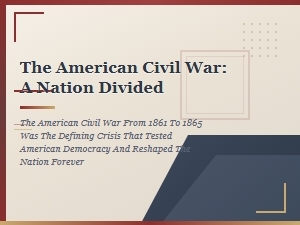 American Civil War Event Overview: Short and Long Sentence Versions
 Describing the Fall of the Roman Empire Using Varied Sentence Structures