History is full of moments that shaped the world but most textbooks describe them in flat, forgettable language. When you rewrite those moments with vivid, descriptive sentences, something shifts. The event stops being a date on a timeline and becomes something people can picture, feel, and remember. That's the power of descriptive historical event sentences, and it's why writers, teachers, and content creators keep searching for them as inspiration.
Whether you're a novelist researching a wartime scene, a teacher building a more engaging lesson plan, or a blogger looking for richer storytelling, strong descriptive sentences rooted in real history give your work weight and authenticity. They help your audience see the smoke rising from the battlefield, hear the crowd's roar at a civil rights march, or feel the tension in a room where a treaty was about to be signed.
What does "descriptive historical event sentences" actually mean?
A descriptive historical event sentence takes a real moment from history and presents it using sensory detail, emotional tone, and precise language. Instead of writing "The Berlin Wall fell in 1989," you might write: "On the night of November 9, 1989, crowds surged toward the Berlin Wall with hammers and pickaxes, chipping away at concrete that had divided families for nearly three decades."
The second version does what the first doesn't it puts the reader inside the moment. It uses visual detail, action, and emotional context. These kinds of sentences don't change history. They make it easier to understand and harder to forget.
Why would someone need descriptive sentences about historical events?
There are several practical reasons people look for this kind of content:
- Writers and novelists need historically grounded language to set scenes accurately in fiction set in the past.
- Teachers and educators want to make lessons more engaging by showing students that history isn't just a list of facts.
- Bloggers and content creators use vivid historical references to add depth and credibility to articles, speeches, or presentations.
- Students search for examples to improve their own descriptive writing skills, especially when assigned essays about historical topics.
- Speechwriters and public speakers draw on well-crafted historical descriptions to open talks with impact.
If you fall into any of these categories, reading and studying strong descriptive sentences about real events can sharpen your own writing. Our guide on descriptive historical event sentences for inspiration offers a wider collection organized by era and topic.
How do you write a descriptive sentence about a historical event?
It starts with the facts. You need to know what happened, when, where, and who was involved. From there, layer in the details that make the moment real:
- Start with a concrete image. What could someone see? "Thick black smoke rolled across the harbor" is stronger than "The attack caused damage."
- Use specific details. Names, dates, locations, and numbers ground your sentence in reality. "At 8:46 a.m." hits differently than "that morning."
- Include the human element. Who was affected? A sentence about the sinking of the Titanic becomes more powerful when you mention the passengers on the lower decks, not just the ship.
- Engage more than one sense. Sound, smell, temperature, and texture all bring a moment to life. The crack of musket fire, the smell of gunpowder, the freezing river water at Valley Forge.
- Avoid editorializing. Let the details do the emotional work. You don't need to say "it was tragic" if your description already makes that clear.
For a deeper breakdown of the rewriting process, we've put together a step-by-step walkthrough on how to descriptively rewrite historical events.
Practical examples that show the difference
Here are a few side-by-side comparisons to illustrate the shift from plain to descriptive:
- Plain: "The Apollo 11 mission landed on the moon in 1969."
Descriptive: "On July 20, 1969, Neil Armstrong's boot pressed into the fine grey dust of the moon's surface, and an estimated 600 million people watched from living rooms, bars, and school auditoriums around the world." - Plain: "The Titanic sank in 1912."
Descriptive: "In the early hours of April 15, 1912, the RMS Titanic broke apart and slipped beneath the freezing North Atlantic, carrying over 1,500 passengers and crew into the dark water." - Plain: "Women gained the right to vote in 1920."
Descriptive: "After more than 70 years of marches, arrests, hunger strikes, and relentless organizing, the 19th Amendment was ratified on August 18, 1920, giving American women the legal right to cast a ballot for the first time."
Notice how the descriptive versions don't add opinion or fiction. They add context, scale, and sensory detail all based on real information from sources like History.com.
What are the most common mistakes people make?
When writers first try descriptive historical sentences, a few problems come up often:
- Adding invented details. You can describe what's known, but don't fabricate dialogue or emotions for real people unless you're clearly writing fiction. Accuracy matters.
- Overloading with adjectives. "The incredibly massive, terrifying, devastating explosion" tries too hard. One precise word works better than four vague ones.
- Losing the facts. A sentence can sound beautiful and still be wrong. Always verify dates, names, and sequences against reliable sources.
- Forgetting the audience. A sentence meant for a middle school classroom will look different from one written for a literary magazine. Adjust your vocabulary and complexity.
- Making it about style over substance. The point is clarity and impact, not showing off. If a simpler word carries the same weight, use it.
Where can I find good historical events to describe?
Almost anywhere in history, if you know where to look. Some rich categories include:
- Turning-point battles and wars D-Day, the Battle of Gettysburg, the fall of Constantinople.
- Civil rights milestones the March on Washington, the abolition of apartheid, the Stonewall uprising.
- Scientific breakthroughs the discovery of penicillin, the first controlled nuclear reaction, the mapping of the human genome.
- Space exploration Sputnik, the Challenger disaster, the Mars rover landings.
- Cultural shifts the invention of the printing press, the first public radio broadcast, the launch of the World Wide Web.
Educators looking to bring these events into the classroom can find structured approaches in our resource on teaching descriptive rewriting with historical events.
How do I get better at this over time?
Like any writing skill, descriptive historical writing improves with deliberate practice. Here are a few habits that help:
- Read primary sources. Letters, newspaper accounts, and firsthand testimony give you language and detail that secondary summaries don't. The National Archives is a strong starting point.
- Rewrite the same event three ways. Try one version that focuses on visual detail, one on sound, and one on the emotional weight. Compare them.
- Study writers who do this well. Erik Larson (Dead Wake), David McCullough (1776), and Isabel Wilkerson (The Warmth of Other Suns) are all strong models of vivid historical writing.
- Keep a sentence bank. When you write or find a descriptive sentence about a historical event that works, save it. Over time, you'll build a personal reference library.
- Read your sentences out loud. If they sound stiff or cluttered, they probably read that way too. Spoken rhythm catches problems your eyes miss.
A quick checklist before you write
Before drafting your next descriptive historical sentence, run through these steps:
- Choose a specific event with a clear date, place, and people involved.
- Verify your facts against at least one reliable source.
- Identify one strong sensory detail what would someone see, hear, or feel?
- Write the sentence without adjectives first. Add only the ones that earn their place.
- Read it out loud. Cut anything that sounds forced or vague.
- Ask yourself: does this sentence make the reader feel closer to the moment?
Start with one event you care about. Write three versions. Compare them. Keep the best one, and build from there.
 How to Descriptively Rewrite Historical Events with Vivid Detail
 Historical Event Sentence Variation Exercises for Descriptive Rewriting Practice
 Vivid Rewriting Techniques for Historical Narratives
 Teaching Descriptive Rewriting with Historical Events: a Guide for Educators
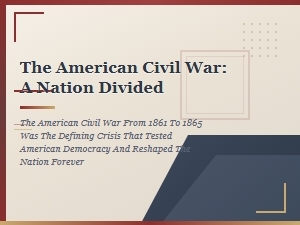 American Civil War Event Overview: Short and Long Sentence Versions
 Describing the Fall of the Roman Empire Using Varied Sentence Structures